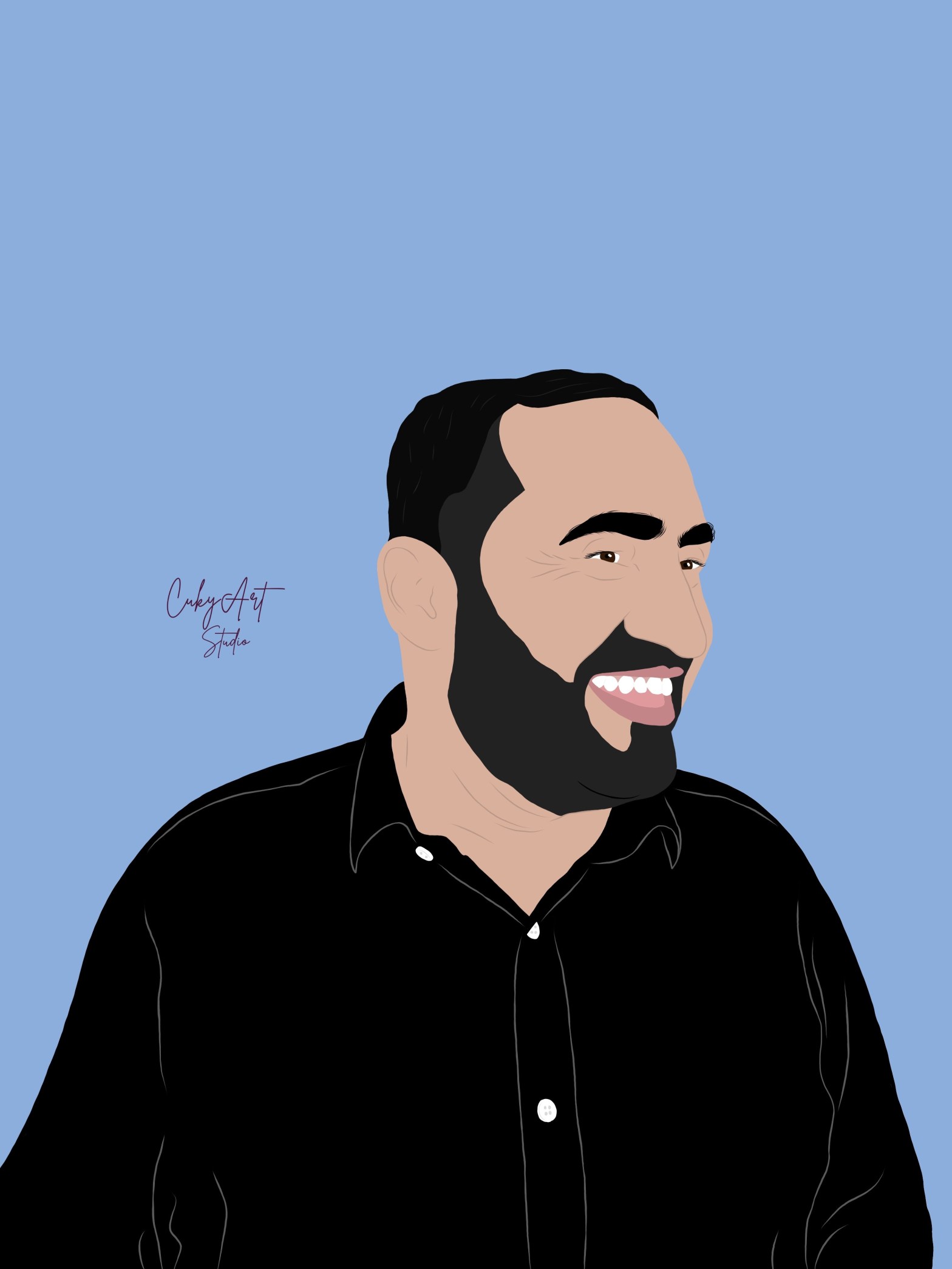
We arrived to Erbil and my father only had one thought in his head: “you have to go to school, you have to go to school”.
We were poor and we had left everything in Baghdad, all the books: we had nothing. Despite everything, we started going to school again. My father managed to find an Arab one, which was a 30 minute walk from our house. So, every day, we walked and went to that school. At the beginning, as soon as we arrived, we did not even have a house, and we found ourselves forced to live with my uncle, who already lived with three wives and twenty-two children and he was very poor. Believe me, that was not a good life. However, after three months, my aunt, the rich one who always helped us, gave us a house, for free.
We finally started a new life: my father started working as a taxi driver, but it was difficult to support everyone (he had six children). He worked a lot and I started feeling a certain responsibility for this situation. This is why, after school, I started selling cigarettes on the street. I would leave my house, go to the Citadel, to the market and shout – Cigarettes, cigarettes, who wants cigarettes? – At the time there was an embargo, nobody had any money. Therefore, I would try to sell cigarettes, chuwingum, then also ice cream.
In 2003 everything changed with America’s invasion of Iraq, we again had to flee to Rowandus. We were afraid of the possible chemical or nuclear weapons that could be used by Saddam Hussein if he bombed Erbil.
I was in my last year of high school. In Iraq the only thing that really counts to get into university is the last year of high school. Based on your final year grades, you can choose whether or not to go to college and which one you can get into. I took all my books, I did not know how long this war would last, and I left with my family for Rowandus. However, America invaded Iraq in a very short time, consequently we managed to get back to Erbil in time for my final exam. I started university but we were still very poor. Therefore, my father decided to start driving trucks from Kurdistan to Baghdad: it was a risky job, few people wanted to do it, but it was well paid. He then asked me to take his place as a taxi driver and I remember that my days at university were divided into two parts: I was both an academic student and a taxi driver.
My father was able to make some money, thus our economic situation started to improve. I graduated in 2008 and got a public job in 2009, I was working in a juvenile prison. But it was terrible. According to the Iraqi law, from the age of 11 to 18, minors can be put in prison just for stealing something. I did not like the experience at all and, after that, I just wanted to become a taxi driver.
A new beginning
From 2005 to 2008 I was a taxi driver and, since they had finally opened the borders of Erbil to foreigners, some NGOs and archaeologists started coming to Iraqi Kurdistan. At the time, the taxi driver did not have a great reputation, many taxi drivers did not behave well with women: they tried to harass them or they took them to the wrong destinations. One day, by chance, a Filipino woman who needed a lift stopped me. I behaved very politely and was correct. Since I had behaved properly and was a good taxi driver, she asked me if she could have my phone number. I gave it to her. I never met that woman again, but she was the one who opened the door to the world for me.
Basically, the Filipino community in Kurdistan used to meet up every Sunday in the church to pray. On many occasions, women would complain that they could not move around, they did not trust taxi drivers, and they had had bad experiences. I want to remind you that it was 2009, people were not very open-minded…The lady then said that she had known me and that I had been a good taxi driver. Another lady then asked her for my phone number. She was Filipino too, but born in Italy. So the next day she called me, but I did not know a single word in English. What I remember of that conversation was just “blah blah blah”, so I put the call down. The lady then sent me a message in English, but I could not read it. Luckily, two days later, a cousin of mine with a degree in English came to see me and translated the message and said, “Oh Haval, this is an Italian teacher from the International School. She would like you as a taxi driver, because she heard that you are an honest person and a recommendable driver”. When my cousin told me that an Italian lady wanted me as a taxi driver, I begged her to call her and to accept immediately.Therefore, I got the address and went in front of the school. As I waited for the lady outside the plexus, I was convinced that an Italian lady would get into my taxi. Instead, a lady with Filipino features entered my car. I was confused not knowing what to do, and I could not speak to her in English. “Let’s go”, she said and she started talking to me. I was even more confused but I trusted and took her to the address I was told. I simply did not realize that she was a Filipino lady, who was born in Italy. She started giving my phone number to all the other teachers: American, British, Australian and New Zealanders. They were calling me every day. I asked my cousin to prepare a message where I explained that I would not answer the phone because I did not speak English and where I asked them to write down the essentials: tell me where I have to take them and what time.
Basically, the Filipino community in Kurdistan used to meet up every Sunday in the church to pray. On many occasions, women would complain that they could not move around, they did not trust taxi drivers, and they had had bad experiences. I want to remind you that it was 2009, people were not very open-minded… The lady then said that she had known me and that I had been a good taxi driver. Another lady then asked her for my phone number. She was Filipina, but born in Italy. So the next day she called me, but I did not know a single word in English. What I remember of that conversation was just “blah blah blah” so I put the call down. The lady then sent me a message in English, but I could not read it. Luckily, two days later, a cousin of mine with a degree in English came to see me and translated the message and said, “Oh Haval, this is an Italian teacher from the International School. She would like you as a taxi driver, because she heard that you are an honest person and a recommendable driver”. When my cousin told me that an Italian lady wanted me as a taxi driver, I begged her to call her and to accept immediately. Therefore, I got the address and went in front of the school. As I waited for the lady outside the plexus, I was convinced that an Italian lady would get into my taxi. Instead, a lady with Filipino features enterned my car. I was confused not knowing what to do, and I could not speak to her in English. “Let’s go”, she said and she started talking to me. I was even more confused but I trusted and took her to the address I was told. I simply did not realize that she was a Filipino lady who was born in Italy. She started giving my phone number to all the other teachers: American, British, Australian and New Zealanders. They were calling me every day. I asked my cousin to prepare a message where I explained that I would not answer the phone because I did not speak English and where I asked them to write down the essentials: tell me where I have to take them and what time.
Thus, my days were spent driving teachers around. I started studying and understanding English and I slowly improved. This Italian lady then decided to introduce me to five Italian archaeologists. She explained that every day I would have to take them from the office to the house they were renting, round-trip, in the morning and in the evening. I became good friends with this group of Italian archaeologists, who changed my lifestyle: every weekend they would take me to the archaeological sites. Thanks to them, I began to discover a new world.
Moreover, in 2011 the school hired twenty more international teachers, my Italo-Filipino friend invited me to the meeting party saying: “Haval we are having a welcome party for new teachers, and I think it can be a good opportunity for your business, so please come, I will speak well of you!”
However at the time, I was following religion very radically and carefully. When I arrived at that party for the first time I saw wine, blond girls in short dresses, and I said to myself, “OH, OH WHAT IS GOING ON”. “OH, OH WHAT IS GOING ON”. I had never even touched a woman’s hand before, not even to introduce myself, and I got mad. When we go to mosque as children, we are told that when we go to heaven we will find blond virgins, with blue eyes. I was so confused…I was young at the time, and for me that meeting had been frightening because I thought as soon as I got out of that party I would go straight to hell. It had been an extreme thing for me. I was confused, sweating. I remember when a woman shook my hand to introduce herself I was embarrassed, then an Irish woman hugged me and I was wooooooow, it was something I had never seen before. That night was terrible for me. I was so embarrassed. As I came home, I decided to go straight to the mosque, to pray and make up for it, I kept saying – PLEASE GOD FORGIVE ME- (laughs).
My business grew because foreigners also paid very well. At the same time, since I was the eldest male child, all my family pressed me on the issue of marriage. Since the business was good, I decided to get married. I met my wife, thanks to a friend. I talked with her for an hour and a half and immediately knew she was the one. We met in December and got married on the second of February.
From selling at traffic lights to becoming one of the country’s most famous tour guides
Let’s now get to the point. How did I become a famous tour guide? On the 20th of February, a few days after the wedding, I received a call. They were three Englishmen, who wanted to go and visit some places, which I had never been to before. I did not even know where they were. But they reassured me, telling me that I knew a little English and I knew Kurdish so we would make it. So for three days I acted as a taxi driver for them, taking them to all the places they requested. We were very close as a group, therefore the man who was sitting next to me in the car told me he was writing a book: “Can I put your name in the book?”. So I asked him what the book was about. He replied “TOURISM”. However, my English was still not very good, I understood “TERRORISM”. And I started saying no. “NO, NO I DON’T WANT TO GO IN YOUR TERRORISM BOOK” But he kept insisting and I kept saying no. Then at a certain point, he told me that it would be a good move for my business, and then I told him to do as he wanted. He informed me that the book would be released in December 2012. But then I forgot.
In January 2013, I received an email: – Hi Haval, I read about you in the Lonely Planet. I would like to ask you to be my guide for my next trip. – I understood absolutely nothing from that email. So I took the car and went to the university, to my friends, to better understand what it was about. I went to my friend Eugenio and asked him: “Sorry, but what is a Lonely Planet? I even looked it up in the dictionary but it does not make sense…”. “Haval, how did your name end up in this book? It is really famous for travellers, for tourism”. This is when I understood that tourism and terrorism are two different things. I then remembered the guy who had asked my permission for the book and my business as a tour guide started there, I paid off all the debts for the house, the wedding, for everything.
I started working for various NGOs that arrived on site to help Syrian refugees and I also worked for archaeologists, international school teachers, and tourists who called me through Lonely Planet. That year was incredible: I got courageous and decided to buy a house, with my wife. She sold some gold she had and I asked a cousin to lend me a plot of land. After that, we built this house. The day before we moved, ISIS had gotten too close to Erbil and everything collapsed. Everyone started calling me, the archaeologists, the teachers and the NGOs: everyone wanted me to take them to the airport. And that night when ISIS was so close, my father called me, worried, asking me to leave, for the umpteenth time, towards Rowandus, towards Iran… My father was worried because all the other brothers had already left Erbil except my wife and me. At the same time, some Finnish Kurds had also called me asking for help with a ride to accompany them to the border and escape. Also, the next day was supposed to be the day my wife and I moved into this house. I decided to give help again as a reward for what I had received. So, that night I gave these Kurdish friends of mine a lift to the border and I decided to move into this house. ISIS never reached Erbil. In any case, after two months, without working, I managed to find a new business: becoming the fixer for the journalists who came to the country, as correspondents, to report what Isis was doing. I was at the front with them, and I risked being killed twice. In 2017, when ISIS was definitively defeated, foreigners slowly returned to Erbil. Moreover, due to the ever-increasing number of refugees, many NGOs have returned to cooperate in the area. Thus, I went back to work and, as I saw that the situation in Iraq was increasingly calm, I had a feeling that Baghdad, the capital, could one day become a safe city. So I asked my wife to go and explore the city: I knew that one day the city would be open to tourists too. I went there every year, until in 2021 the Pope, by visiting Iraq, made it possible again to open its borders to international tourists. And so, with the arrival of the first tourists, my business exploded. I managed to repay all the debts on the house and now I have a new project: to build a hostel in the mountains near a canyon, here in Kurdistan. Thank God everything is fine now. I believe in karma: if you do good things, good things will come back to you.
 Grandi Storielle 🖌📚